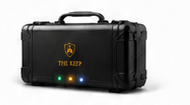
Mobile Keep™
Portable case
Self-contained for a private office, branch location, field deployment or secure demonstration.

The Keep™ is a private, company-owned intelligence hub that unifies your data, workflows and AI under your control.
Your team did not vote to move customer notes, pricing logic, strategy and institutional memory into a fragmented tool stack. It drifted there.

Where does the intelligence of your company live?
One secure environment you own and control, holding data, customer knowledge, AI agents, workflows, documents and systems. Unlike a rented platform, it keeps your most valuable asset inside the company.

Size for the workload, not the label. Every Keep includes secure boot, TPM-backed key storage, full-disk encryption, remote management, monitored backups and a documented replacement path.
Portable case
Self-contained for a private office, branch location, field deployment or secure demonstration.
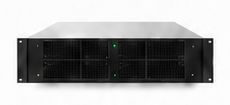
1RU rack server
Rack-mounted infrastructure for an office, data center or colocation environment.

Private cloud
A dedicated deployment inside your own Virtual Private Cloud, with no onsite appliance.
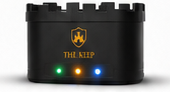
Boardroom edition
A visible statement of strategic control, at the level where direction is set.
Deployed and supported through your MSP or authorized reseller. Find a partner
Approved sources feed a hub you control. Governed AI, workflows, memory and communications run inside your boundary — and the outputs return to your people, not to a vendor's platform.
Every result returns as governed input — the loop compounds inside your boundary
Data, permissions, memory and workflow logic never leave the boundary. Approved external services connect through governed interfaces.

The danger is not that businesses use too many tools. It is that the tools are becoming the business.
The objective is control, interoperability and operating value — not ideological purity. Components are chosen by function and replaced as technology, licensing or your needs change.
| Component | Role | What it does | License posture |
|---|---|---|---|
| Ollama | Local AI runtime | Runs supported models on customer-controlled hardware. | MIT runtime; per-model licenses |
| Open WebUI | Private AI interface | Self-hosted access to models, knowledge and assistants. | Branding provisions — review |
| PostgreSQL | Structured data | Operational, application and customer data foundation. | PostgreSQL License |
| pgvector | Semantic memory | Vector storage and similarity search for embeddings and RAG. | PostgreSQL-style |
| Crawl4AI | Governed ingestion | Collects approved web content for AI-ready knowledge. | Apache 2.0; attribution |
| Whisper | Speech-to-text | Turns meetings and media into searchable text, locally. | MIT code and weights |
| n8n | Workflow orchestration | Connects models, data, email, documents, CRMs and APIs. | Fair-code Sustainable Use |
| WordPress + FluentCRM | Owned publishing | Content, portals, campaigns and customer journeys. | GPLv2+; Pro tiers commercial |
| EspoCRM | Self-hosted CRM | Accounts, contacts, opportunities and customer history. | AGPLv3 — review obligations |
License summaries are planning guidance only. Confirm current source, dependencies, redistribution, branding and commercial terms before bundling or committing to a deployment.
Planning profiles, not a frozen bill of materials. Final sizing depends on model choice, concurrency, data volume, availability requirements and your partner's security standard.
| Specification | Small | Medium | Large |
|---|---|---|---|
| Typical users | 25–100 | 100–500 | 500–2,500+ |
| Workflow scale | 1–3 priority | 5–15 production | 15–50+ and agent services |
| CPU | 12–16 cores | 24–32 cores | 32–64 server-class |
| Memory | 64 GB ECC | 128 GB ECC | 256–512 GB ECC |
| AI acceleration | Optional 16–24 GB | 32–48 GB VRAM | Dual 48 GB or 80 GB-class |
| Usable NVMe | 2 TB mirrored | 4–8 TB protected | 8–32 TB expandable |
| Networking | 2.5–10 GbE | Dual 10 GbE | Dual 10/25 GbE, segmented |
| Availability | Single node, encrypted backup | Redundant storage, spare unit | HA, redundant power, failover |
Local model performance varies materially by architecture, quantization, prompt length and concurrent demand. Benchmark the actual workload before procurement.
A spin-out from PublioSTUDIO, built in 90 days on sovereign architecture. The team stopped assembling the machine every week and started using it.

The architecture that produced this result is the architecture on offer.
The decision to own is easy at $17,500. It becomes prohibitive at an unexpected $750,000.
$17,500–$75,000
$700–$3,500/mo
Services such as AI models, middleware and email delivery are pass-through and outlined in the proposal.
A governed micro-deployment with named outcomes, not a platform mandate. Every phase has an exit gate — the work does not advance until it is done, and it does not drift either.
Thirty minutes. Map the stack and find the right first move.
Confirm goals, scope, RACI, access and success metrics.
Core hub, integrations and first workflows live in QA.
Team trained. Runbook approved. Real outputs flowing.
Measured outcomes. Expansion backlog. Managed operations.